How Custom Gobo Slides Create Realistic Water Wave Effects: A Technical Guide
Sep 24,2025 | JINGYU OPTOELEC
For lighting designers, event planners, or business owners aiming to add an aquatic ambiance to spaces, gobo water effects are a game-changer—they transform plain walls, floors, or backdrops into surfaces that mimic the gentle ripples of a pond, dynamic ocean waves, or even cascading waterfalls. But how exactly do custom gobo turn static light into lifelike water movement? This article breaks down the technical process, key components, and practical tips to achieve convincing water wave effects with gobos.
1. The Core Principle: Light + Pattern = Simulated Water Movement
At its heart, a gobo water effect relies on two simple but precise elements: a custom gobo pattern and controlled light projection. Unlike generic gobos with fixed shapes, water effect gobos are engineered to replicate the irregular, flowing lines of water. When light passes through the gobo’s etched or printed pattern, it casts a shadow that mimics water’s natural texture—think soft concentric ripples, overlapping wave crests, or scattered light reflections off the water surface.
The “movement” of the water effect (a key factor in realism) comes from one of two methods:
- Static gobo + dynamic lighting: The gobo itself is fixed, but the lighting fixture is adjusted slightly (e.g., gently rotating the gobo holder, tilting the light, or dimming the brightness in pulses). This creates the illusion of water shifting—like wind rippling a pond.
- Dynamic gobo designs: Some custom gobos use layered patterns or subtle asymmetries. When paired with a rotating gobo wheel (a small accessory for most track lights or projectors), the overlapping patterns blend as they spin, simulating the continuous flow of waves.
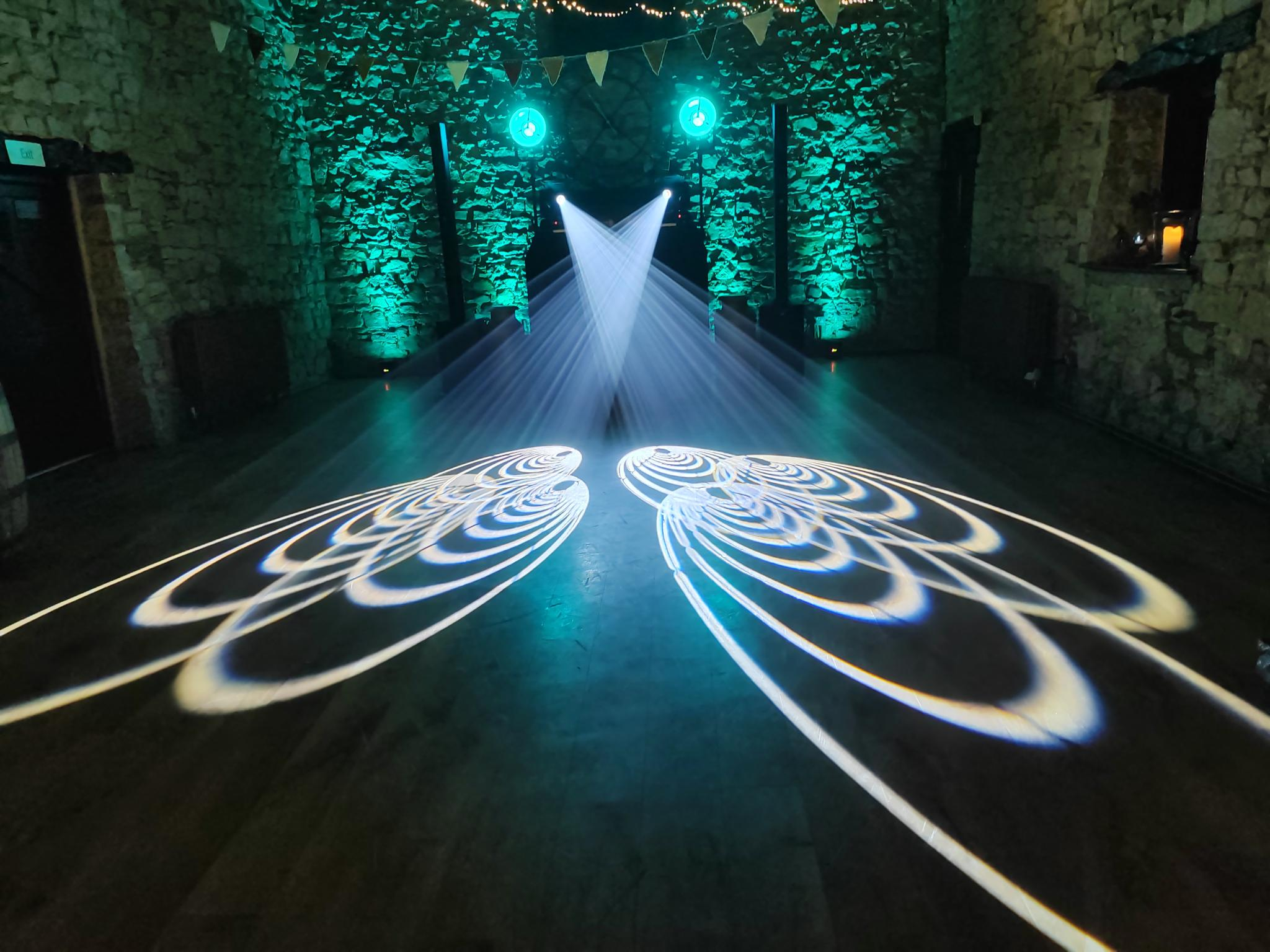
For example, a static gobo with “half-moon ripple” patterns, paired with a slowly rotating light fixture, can project ripples that appear to expand outward—just like dropping a stone into water.
2. Gobo Material Choices: Which Works Best for Water Effects?
Not all gobo materials are equal when it comes to water wave effects. The material determines how sharp the pattern is, how well it holds up to heat, and how realistic the final projection looks. Here’s how the three main materials perform:
Glass Gobos: The Top Choice for High-Definition Water Ripples
Glass gobos are the gold standard for realistic water effects, thanks to their high optical clarity and ability to handle fine details. To create a water pattern, manufacturers etch or print microscopic lines and curves onto a thin borosilicate glass slide (the same heat-resistant glass used in laboratory equipment). These details replicate the tiny variations in water—like the way light bends around a ripple or reflects off a wave peak.
Glass gobos also support full-color printing, which is critical for water realism. Adding subtle gradients of blue (for deep water) or green (for shallow ponds) to the gobo pattern mimics how sunlight filters through water, avoiding the “flat” look of monochromatic projections. For instance, a glass gobo with a “light blue base + white reflection spots” can project water that looks like it’s glistening in sunlight.
Their heat resistance is another advantage: glass gobos won’t warp under the warmth of LED or halogen lights, so the water pattern stays sharp even during long events (e.g., a 4-hour wedding reception).
Metal Gobos: Durable for Bold Wave Silhouettes
Metal gobos (usually made of stainless steel or aluminum) are better suited for bold, high-contrast water effects—like the silhouette of crashing waves or large, dramatic ripples. They’re created by laser-cutting the water pattern into a thin metal sheet, which blocks light in some areas and lets it pass through others.
While metal gobos can’t match glass’s fine detail (they’re limited to monochromatic projections), they’re incredibly durable. This makes them ideal for outdoor use (e.g., projecting wave effects onto a restaurant patio wall) or long-term installations (like a hotel lobby’s permanent water-themed lighting).
A common trick with metal gobos: pair a “wave crest” metal gobo with a warm yellow light to simulate sunset reflecting off ocean waves—creating a bold, eye-catching effect.
Plastic Gobos: Budget-Friendly for Temporary Water Effects
Plastic gobos are the most affordable option, made from heat-resistant PET plastic. They’re a good choice for short-term events (e.g., a one-night birthday party with a “beach theme”) where cost is a priority. However, their lower clarity means water patterns may look slightly blurred, and they can’t handle as much heat as glass or metal—so they’re best used with low-wattage LED lights.
For casual use, though, plastic gobos work well: a simple “circular ripple” plastic gobo can still create a convincing pond effect when projected onto a dark floor.
3. Lighting Fixture Compatibility: What You Need to Project Water Effects
Even the best water gobo won’t work without the right light. The fixture determines the size of the projection, the brightness, and whether you can add dynamic movement. Here are the most compatible fixtures:
Ellipsoidal Spotlights: For Precise Ripple Control
Ellipsoidal spotlights (often called “ELLs” in lighting terms) are the top choice for indoor water effects. They let you adjust the beam angle (from narrow 10° to wide 60°) and focus the light sharply—critical for making water ripples look defined. For example, a narrow beam angle (15°) can project small, tight ripples onto a tabletop, while a wide angle (45°) can cover an entire wall with a “pond” effect.
Most ellipsoidal spotlights also have a “gobo slot” where you can insert the gobo slide directly, plus a rotating mechanism to spin the gobo—perfect for creating moving waves.
LED Projectors: For Large-Scale Outdoor Water Effects
For outdoor spaces (e.g., projecting waves onto a building facade) or large indoor areas (like a convention hall), LED projectors are ideal. They’re bright enough to cut through ambient light, and many come with built-in gobo holders. Look for projectors with “adjustable zoom” to scale the water pattern—from a 2-meter “pond” to a 10-meter “ocean.”
LED projectors also stay cool, which is important for plastic or glass gobos: no heat means the water pattern won’t distort, even during evening-long events.
Track Lights: For Flexible Small-Space Water Effects
Track lights are a budget-friendly option for small spaces (e.g., a café or boutique). Most track lights accept gobo adapters (small plastic or metal holders that fit the gobo slide), and you can move the track head to adjust where the water pattern lands—e.g., projecting ripples onto a coffee bar or a clothing display.
Pro tip: Use two track lights with matching water gobos, angled slightly differently, to create overlapping ripples—this mimics the natural chaos of real water.
4. Design Tips to Make Water Effects More Realistic
Even with the right gobo and fixture, small design choices can take your water effect from “good” to “wow.” Here are three key tips:
1. Add Irregularity to the Pattern
Real water isn’t perfectly symmetrical—so your gobo shouldn’t be either. Ask your manufacturer to add subtle variations: e.g., one ripple that’s slightly larger than the others, or a wave crest that’s off-center. This avoids the “mechanical” look of identical repeating patterns.
2. Use Light Color to Match the Scene
The color of your light changes how the water effect reads:
- Cool white light + blue glass gobo = deep ocean waves
- Warm yellow light + green glass gobo = shallow pond in sunlight
- Soft purple light + clear glass gobo = nighttime water with moonlight reflections
For example, a wedding with a “beach sunset” theme could use a warm orange light paired with a orange-tinted glass gobo—projecting waves that look like they’re glowing at dusk.
3. Adjust Projection Distance
The farther the light is from the surface, the larger (and softer) the water pattern will be. For a “close-up pond” effect, place the fixture 1–2 meters from the wall/floor—this creates sharp, small ripples. For a “wide ocean” effect, move the fixture 3–5 meters away—ripples will blend slightly, mimicking the vastness of open water.
Conclusion: Achieving Perfect Water Effects with Custom Gobos
Creating realistic water waves with gobos is a mix of technical precision and creative design: start with a high-quality glass or metal gobo with irregular, detailed patterns, pair it with a compatible fixture (ellipsoidal spotlight for indoors, LED projector for outdoors), and tweak the light color and distance to match your scene. Whether you’re adding ripples to a wedding dance floor, ocean waves to a restaurant patio, or a pond to a retail display, custom gobos offer an affordable, flexible way to bring water’s beauty to any space.
发表评论